
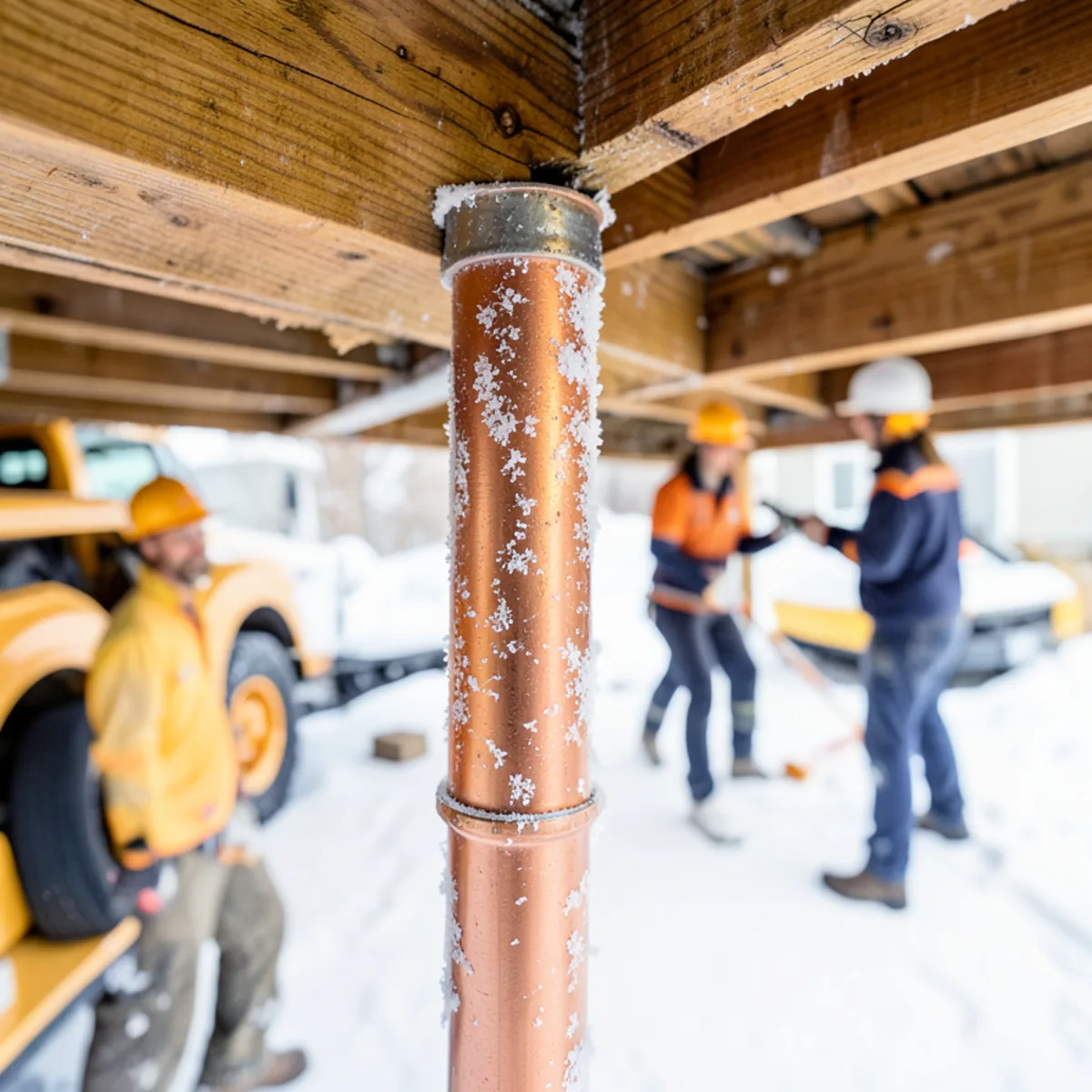
Water expands by roughly 9% when it freezes into ice. In a closed copper or PEX plumbing line, this expansion exerts immense hydrostatic pressure—often exceeding 2,000 PSI—between the ice blockage and closed indoor valves. If left unmanaged, the pipe wall splits, setting off an active flood the moment temperatures rise.
How to Recognize a Frozen Pipe Before It Bursts
Catching a freeze early allows you to thaw the line safely before the metal wall tears:
- No Water or Weak Trickle: Turning on a kitchen or bathroom sink produces only a few drips or nothing at all on a freezing morning.
- Visible Frost on Exposed Metal: In unheated basements, crawlspaces, or utility rooms, look for frost crystals or bulging along copper pipe sections.
- Strange Odors from Drains: If an ice blockage prevents sewer gas venting, unpleasant smells can back up through sink traps.
The Safe, Step-by-Step Thawing Protocol
Follow these trade-tested rules to safely restore water flow without damaging your plumbing:
- 1Open the Affected Faucet: Turn on the faucet handles (both hot and cold) connected to the frozen run. As the ice plug melts, water needs a clear path to escape.
- 2Locate the Ice Blockage: Check pipes located along exterior walls, beneath kitchen sinks on outside walls, in unheated crawlspaces, and near foundation rim joists.
- 3Apply Gentle Heat Gradually: Use an electric hairdryer, a portable space heater set at a safe distance, electric heating pads wrapped around the pipe, or towels soaked in hot water. Always start applying heat at the faucet end of the freeze and work backward toward the blockage.
- 4Never Use Open Flames: Never, under any circumstances, use a propane blowtorch, kerosene heater, or open flame to thaw a frozen pipe. Open flames ignite dry wood framing and cause rapid steam expansion inside the pipe that can explode the fitting.
Need Urgent Plumbing Assistance in Greater Hartford?
Connect with an independent local pro ready to dispatch across Glastonbury, East Hartford, Manchester, and surrounding towns. Free to call with upfront written estimates.
Long-Term Freeze Prevention for Hartford County Homes
Proactive winterization prevents recurring freeze emergencies each winter:
Why Exterior Wall Cavities and Rim Joists Freeze in Connecticut Winters
During sub-zero polar vortex events in January and February, outdoor temperatures in Hartford County can plunge below zero degrees Fahrenheit with biting northwest winds. Residential plumbing pipes routed through exterior walls, unheated garage ceilings, or along foundation rim joists are exceptionally vulnerable. When fiberglass batt insulation is compressed or air leaks around sill plates allow cold drafts to enter floor cavities, the temperature surrounding water pipes drops below 32°F within hours.
As water freezes inside a rigid copper pipe, it expands volumetrically by approximately 9 percent. Contrary to popular belief, the pipe rarely bursts at the exact spot where the ice blockage forms. Instead, as the ice plug expands, it acts like a piston, compressing trapped liquid water between the ice blockage and the closed downstream faucet. Pressure inside the pipe spikes dramatically—often exceeding 2,000 PSI—causing the copper pipe wall to tear open lengthwise.
Step-by-Step Safe Pipe Thawing Technique
- 1Open the Faucet First: Before applying any heat, open the faucet connected to the frozen pipe. As the ice begins to melt, steam and water need an exit path, and running water helps accelerate melting.
- 2Locate the Ice Blockage: Feel along the exposed pipe in the basement, crawlspace, or uninsulated wall. The frozen section will feel ice cold to the touch and may exhibit visible frosting or slight bulging.
- 3Apply Gentle, Uniform Heat: Use an electric hair dryer, heat lamp, or portable space heater directed toward the pipe. Always work from the open faucet backwards toward the frozen blockage to prevent pressure buildup.
- 4Never Use Open Flame Torches: Open-flame propane torches ignite dry wooden studs and paper-faced insulation in seconds. Additionally, intense localized heat creates thermal shock that fractures pipe walls.
Long-Term Freeze Prevention Strategies for Greater Hartford Homes
- Seal Rim Joist Air Infiltration: Use expanding closed-cell spray foam along basement rim joists and sill plates to seal out freezing outdoor drafts.
- Install Foam Pipe Insulation Sleeves: Wrap all domestic supply lines running through unheated basements, crawlspaces, or utility rooms with thick pre-slit polyethylene foam insulation.
- Open Vanity Cabinet Doors During Sub-Zero Snaps: Allow warm room air to circulate around plumbing pipes located on exterior bathroom and kitchen walls.
- Disconnect Outdoor Garden Hoses Before First Frost: Leaving a garden hose attached to an outdoor sillcock traps water inside the wall fitting, freezing and splitting the interior valve body.
Frost-Free Outdoor Sillcock Maintenance & Winter Drain Down
Most modern Connecticut homes feature "frost-free" outdoor hose bibs designed with a long stem that seals inside the warm basement. However, a frost-free sillcock only works if the garden hose is completely disconnected before the first freeze. Leaving a garden hose attached holds water inside the exterior barrel; when winter frost strikes, this trapped water freezes and ruptures the copper casing inside your wall. In older homes with standard brass faucets, always close the interior shutoff valve in the basement, open the outdoor spigot, and remove the small bleeder cap on the valve body to drain all residual water before winter sets in.
Freeze Risk Assessment by Plumbing Material in Connecticut Homes
Different plumbing materials react to winter sub-zero freeze expansion in distinctly different ways. Understanding the specific material installed behind your walls helps prioritize winterization investments:
| Material Type | Typical Era in CT | Freeze Tolerance | Failure Mode & Risk |
|---|---|---|---|
| Type M Copper | 1960s–1990s Subdivisions | Poor (Rigid Thin-Wall) | Splits lengthwise under 2,000 PSI hydraulic ice piston pressure; causes sudden high-volume floods |
| Type L Copper | Commercial & Quality Builds | Moderate (Thicker Wall) | Withstands slight pressure spikes but tears along longitudinal seams during prolonged sub-zero snaps |
| PEX-A (Cross-Linked) | 2000s–Present Renovations | Exceptional (Elastic) | Expands up to 300% of diameter and contracts back to memory; brass fittings remain vulnerable if uninsulated |
| CPVC Plastic | 1980s–2000s Additions | Very Poor (Brittle) | Becomes extremely brittle below 32°F; fractures and shatters catastrophically under slight ice expansion |
Expert Field Insight: Commercial Electrical Thawing vs. Thermal Shock Hazards
In professional field service across Greater Hartford, emergency plumbing specialists rely on commercial low-voltage pipe thawers or controlled hot-water recirculation probes rather than high-heat open flames. Using a propane blowtorch to thaw frozen copper lines is one of the leading causes of residential winter structure fires in Connecticut. Beyond the obvious fire risk to dry hemlock wall studs and kraft-faced fiberglass insulation, intense localized torch heat creates severe thermal shock. Flash-heating an ice plug inside a closed metal pipe generates localized superheated steam pockets exceeding 500 PSI, which can violently blow copper solder joints apart like shrapnel.
Professional electrical thawing machines pass safe, low-voltage, high-amperage alternating current across continuous metal pipe runs between two connection clamps. The electrical resistance of the copper generates gentle, uniform warmth along the entire length of the frozen segment simultaneously. This melts the outer ice boundary within minutes, allowing municipal line pressure to blow the slush out safely through an open faucet without stressing pipe walls.
Emergency Vacation Winterization & Domestic Water Drain-Down
If you plan to leave your Connecticut home unattended during winter months or after an unexpected heating system failure, a proper gravity drain-down protects against catastrophic whole-house freezing. Begin by shutting off the main water valve completely. Next, open every sink, shower, and tub faucet starting from the top floor down to the basement laundry tubs. Flush every toilet to empty the tanks, and pour non-toxic propylene glycol marine antifreeze into all sink P-traps, shower drains, and toilet bowls. Antifreeze displaces standing water in the trap seals, preventing sewer gases from entering while eliminating the risk of porcelain cracking under sub-zero indoor temperatures.
Crawlspace & Cantilevered Floor Winterization Protocols
Many Connecticut split-levels and colonial homes built in towns like Glastonbury, Manchester, and Vernon feature architectural cantilevers—where second-floor bathrooms or kitchen sinks extend 12 to 24 inches outward past the foundation wall. The floor bays beneath these overhangs are exposed to freezing ambient air from three directions. If floor insulation settles or shifts, arctic drafts blow directly across domestic water piping. For high-risk cantilevered floor cavities and unheated crawlspaces, independent plumbing pros install self-regulating electric heat trace cable (delivering 5 to 8 watts per linear foot) beneath pre-formed closed-cell elastomeric foam insulation sleeves, automatically energizing when pipe temperatures dip toward freezing.
Visual Field Reference & Diagnostic Guides
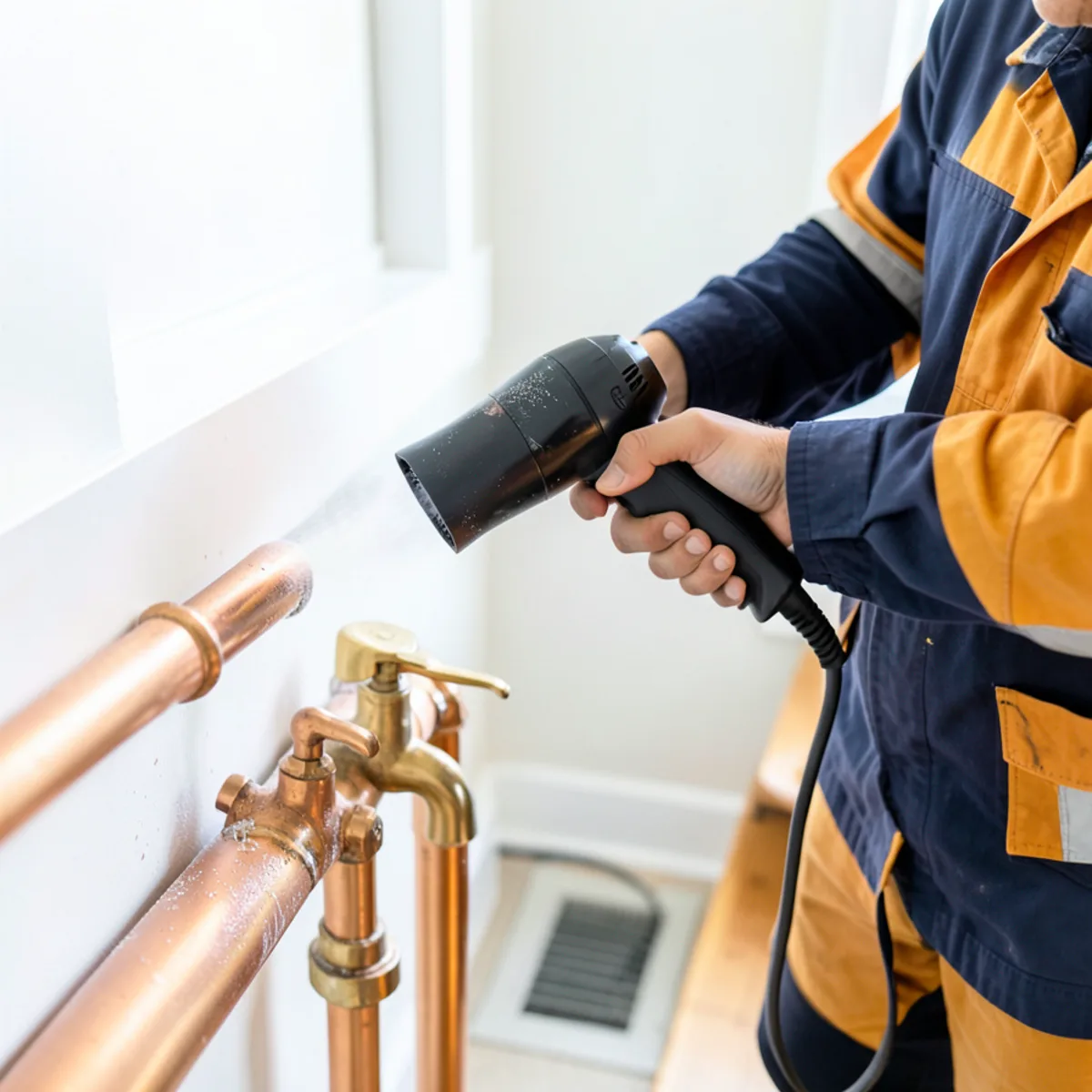
Thawing a frozen pipe safely with an electric hairdryer

Installing foam insulation tube over copper water line

Brass frost-free outdoor sillcock faucet showing stem tube
Cited References & Regulatory Authorities
Article FAQs
Direct answers to common questions addressed in this guide.
The physical rupture occurs when water freezes and expands, tearing the pipe wall. However, because the ice plug itself blocks the breach, no water leaks out while temperatures remain below freezing. The flood occurs when the house warms up, melting the ice plug and letting pressurized water pour through the tear.